
LinkedIn is the highest-value channel in B2B marketing right now, and most brands are using it wrong. They post from company pages that nobody follows, run lead gen forms that nobody fills, and wonder why their cost per qualified lead keeps climbing. The problem is not LinkedIn. The problem is a strategy built for 2019 running in 2026.
This post is the blueprint that actually works today: what to optimize, what to create, how to use paid amplification intelligently, and how to turn LinkedIn into an inbound engine that generates pipeline without burning budget on low-intent audiences.
Why Company Pages Are Not Enough Anymore
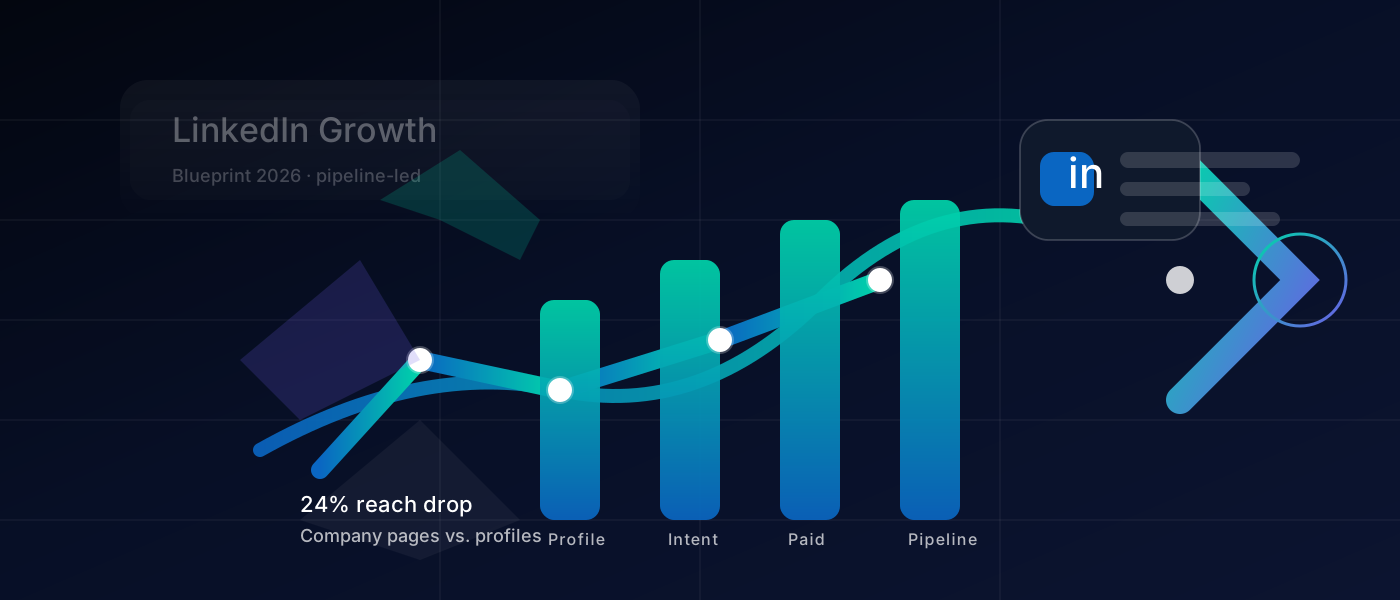
LinkedIn's algorithm has been systematically deprioritizing company page content since 2023. The platform wants personal connection, conversation, and human-to-human engagement. Brand broadcasts from logo accounts simply do not fit that model, and the reach data confirms it.
The brands winning on LinkedIn in 2026 have shifted their center of gravity to personal profiles — founders, executives, and subject matter experts — and use the company page primarily for credibility signals rather than content distribution. This is not a workaround. It is the correct strategy for how the platform actually works.
Your company page is a landing page. Your personal profile is your growth engine. The brands that understand this distinction are building pipelines that compound month over month.
Pillar 1: Profile Engineering
Before you create a single piece of content, your profile needs to function as an inbound landing page. Most B2B professionals have a profile that reads like a resume. That is the wrong frame entirely. Your LinkedIn profile should answer one question for every visitor: "Why should I trust this person with my problem?"
The headline formula that converts
Your headline is the most-read line on your entire profile. It appears in search results, comment threads, connection requests, and InMail previews. The formula that works: [What you do] + [Who you do it for] + [The outcome they get]. A headline like "B2B Content Strategy for SaaS Brands | Helping Companies Build Organic Pipeline Through AEO and LinkedIn" beats "Founder at [Company Name]" on every conversion metric.
The About section as a sales page
Most people write their About section in third person and bury the value proposition under their career history. Reverse it entirely. Open with the specific problem you solve, name the type of client you work with, and include one concrete proof point — a metric, a client win, or a methodology that only you have. End with a clear call to action and your contact information.
Featured section as a portfolio
The Featured section is prime real estate that most profiles leave blank or fill with generic content. Use it for three things: your best-performing post (social proof), a case study or lesults document (conversion asset), and a direct booking link or contact form (friction reducer). These three elements alone will increase profile-to-lead conversion rates significantly.
Run through these before anything else: headline includes a target audience and outcome, profile photo is professional and recent, About section opens with a problem statement, Featured section has at least two conversion assets, and the Experience section includes quantified results rather than job descriptions.
Pillar 2: Content That Builds Pipeline
The goal of LinkedIn content for B2B is not vanity metrics. It is not follower count. It is not even engagement rate. The goal is to get the right 500 people — your actual ICP — to read your content every week and associate your name with the solution they need. That requires a very specific content approach.
The three-format weekly cadence
The content mix that consistently performs for B2B brands follows a weekly rhythm across three formats. Each one serves a different role in the pipeline-building process.
- Educational post (Monday or Tuesday): Data-led, framework-based, or step-by-step instructional content. This builds authority. It tells your audience you understand their problem at a deeper level than most. Carousels, numbered lists, and "here is how I do X" posts fall into this category.
- POV or opinion post (Wednesday or Thursday): A clear, specific take on something happening in your industry. This builds trust and sparks conversation. It is the content that makes your ICP think "this person actually gets it." Avoid being diplomatic here. Lukewarm opinions generate lukewarm engagement.
- Social proof post (Friday): A client win, a metric you hit, a testimonial, or a case study insight. This builds confidence. It is the content that moves someone from "I find this person interesting" to "I want to talk to this person." Keep it specific — percentages, timeframes, and named outcomes beat vague success stories every time.
Three posts per week is the minimum effective dose for LinkedIn growth. Fewer than that and you lose momentum with the algorithm and with your audience.
What makes a LinkedIn hook actually work
The first line of every LinkedIn post determines whether anyone reads the second line. LinkedIn truncates posts after roughly two lines before a "see more" click, which means your hook is doing all the heavy lifting. Strong hooks either make a counterintuitive claim ("Most B2B content strategies fail for the same reason"), reveal a specific number ("We generated 47 inbound leads last quarter from one type of LinkedIn post"), or promise a concrete deliverable ("Here is the exact 5-step framework I use to write LinkedIn posts that convert to pipeline").
Avoiding the reach collapse trap
LinkedIn penalizes posts that send people off-platform. External links in the body of a post — not the comments, in the body — consistently reduce reach by 30% to 50% in testing. The fix is simple: post your content without a link, put the link in the first comment, and reference it at the end of the post. This one change alone recovers the reach that most brands are unknowingly throwing away.
Pillar 3: Intent Signal Tracking
This is the pillar most B2B LinkedIn strategies completely skip, and it is where the easiest pipeline comes from. Intent signals are behavioral cues that tell you a prospect is actively evaluating a solution like yours. LinkedIn surfaces several of them directly.
Profile views as a warm outreach trigger
When someone from your ICP visits your profile, they have just raised their hand. LinkedIn Premium and Sales Navigator both show you who has viewed your profile in the past 90 days. A connection request paired with a short, non-salesy message sent within 24 to 48 hours of a profile view converts at a dramatically higher rate than cold outreach. You are not starting a conversation — you are continuing one that they initiated.
Post engagement as a segmentation signal
Everyone who likes, comments on, or shares your posts is telling you something about their current state of mind. Export your post engagement lists regularly. Filter for job titles that match your ICP. Anyone who has engaged with three or more of your posts is a warm prospect who knows your work — a very different starting point than a cold contact who has never encountered your brand.
Competitor content engagement
Sales Navigator allows you to monitor engagement on competitor posts. Someone who is actively engaging with your competitor's thought leadership is in-market right now. They have the problem. They are actively evaluating solutions. A well-crafted connection request from a credible personal profile — not a company page message, never a company page message — will land with far more resonance than any other type of outreach.
Rank your outreach by signal strength: profile viewers from ICP (highest intent), repeated post engagers (high intent), competitor content engagers (medium-high intent), job change triggers in target accounts (medium intent). Work the list in this order every week before doing any cold outreach.
Pillar 4: Paid Amplification That Actually Works
LinkedIn Ads have a reputation for being expensive. That reputation is deserved — if you run them the wrong way. The brands paying $200 per lead on LinkedIn are typically running standard Sponsored Content from company pages to broad audiences. The brands paying $40 to $60 per lead a2e running a fundamentally different playbook.
Thought Leader Ads: the highest-ROI format in 2026
Thought Leader Ads allow you to sponsor content published by a personal profile rather than a company page. The difference in performance is substantial. When a post appears to come from a real person rather than a brand, trust is higher, engagement is higher, and click-through rates are significantly better. The optimal workflow: publish three organic posts per week, identify the one that is outperforming organically after 48 hours, and put $50 to $150 behind it as a Thought Leader Ad to your ICP audience. This amplifies content that you already know resonates rather than gambling budget on untested creative.
Audience targeting that reduces waste
The most common LinkedIn Ads mistake is targeting too broadly. A $5,000 monthly budget spread across 500,000 people produces almost no frequency, which means almost no brand memory, which means almost no pipeline. The same budget concentrated on 20,000 to 30,000 people in a tightly defined ICP — specific job titles, company sizes, industries — generates the frequency needed for someone to actually remember your brand when they have a relevant problem.
The retargeting layer most brands skip
LinkedIn allows you to retarget people who have engaged with your content, visited your website, or satched a certain percentage of your video ads. This audience is dramatically cheaper to convert than cold traffic because the trust foundation is already partly built. Run your strongest case study or social proof content to this retargeting pool. These are the people closest to a conversation — prioritize them accordingly.
Measuring LinkedIn as a Pipeline Channel
The metrics that matter for a pipeline-oriented LinkedIn strategy are different from what most marketing teams track. Follower growth and impression counts are vanity metrics. The numbers that connect LinkedIn activity to revenue are more specific.
- Profile-to-DM conversion rate: Of the people who visit your profile, how many initiate or accept a conversation? This tells you whether your profile is doing its job as an inbound landing page.
- Content-to-meeting rate: Of the people who engage with your content consistently, how many convert to a discovery call or sales conversation within 90 days? Track this cohort manually if you have to.
- Inbound attribution from LinkedIn: Ask every new prospect "how did you hear about us?" and track LinkedIn separately from other channels. Self-reported attribution is imperfect but it is far better than nothing for a channel that is hard to track directly.
- Cost per sales-qualified lead from ads: Not cost per click, not cost per lead form submission — cost per lead that actually enters your sales process. This is the number that tells you whether your LinkedIn ad investment is working.
The 90-Day LinkedIn Growth Sprint
If you are starting from zero or resetting a stalled strategy, here is a focused 90-day plan to build the foundation and start generating pipeline.
- Days 1 to 10 — Profile and foundation: Rebuild your personal profile using the engineering principles above. Identify three to five executives or subject matter experts who will become your content voices. Set up Sales Navigator and configure intent signal monitoring for your ICP.
- Days 11 to 30 — Content establishment: Post three times per week with the format cadence described above. Focus on educational content first to build authority before making any commercial moves. Engage genuinely with ten posts per day in your niche — not shallow comments, but substantive responses that demonstrate expertise.
- Days 31 to 60 — Warm outreach activation: Begin working your intent signal lists systematically. Profile viewers, post engagers, and competitor content engagers are your first outreach targets. Personalize every message based on the specific signal that triggered your outreach.
- Days 61 to 90 — Paid amplification layer: Launch Thought Leader Ads behind your two or three best-performing organic posts from the previous 60 days. Run them to a tightly defined ICP audience. Set up a retargeting campaign for website visitors and content engagers. Review results at the 90-day mark against the pipeline metrics that matter.
At 90 days, you should have a functioning content operation, a warm prospect list built from intent signals, and early data on which paid formats are generating pipeline. The compounding effects — increased inbound profile views, growing brand recognition in your ICP, and a retargeting pool that grows every week — continue to build from there.
What Most B2B LinkedIn Strategies Get Wrong
Before closing, it is worth naming the most common mistakes that derail LinkedIn growth strategies, because avoiding them is half the battle.
Posting without a point of view. Generic educational content that could have been written by anyone in your industry generates generic results. Your content needs a perspective — a take, a framework, or an approach that is distinctly yours. That specificity is what makes someone remember you when they have a relevant problem three months after reading your post.
Treating LinkedIn as a broadcast channel. The brands that grow fastest on LinkedIn spend as much time engaging with others' content as they spend creating their own. Comments on your ICP's posts, genuine responses to industry conversations, and public dialogue with peers all drive profile visibility in ways that solo broadcasting cannot replicate.
Separating content and sales too rigidly. Content builds the relationship, but someone still needs to move the conversation forward. A quarterly direct reach out to warm prospects — people who have been engaging with your content but have never been contacted — is a legitimate and high-converting tactic when it is done with enough personalization and without a pitch in the opening message.
LinkedIn in 2026 rewards brands that think like publishers, engage like people, and sell like advisors rather than vendors. The blueprint above is built on that premise. The brands executing it consistently are generating more inbound pipeline from LinkedIn than from any other digital channel.